Tether Unveils QVAC: Universal AI Engine
Tether Unveils QVAC: Universal AI Engine
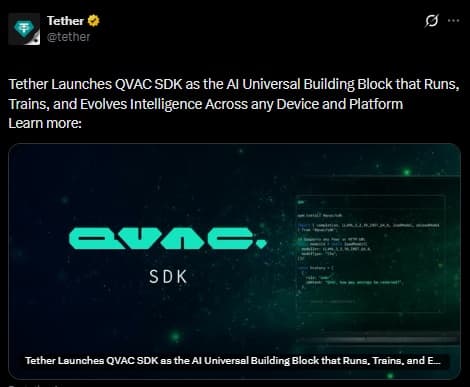
Tether launches QVAC SDK, an open-source AI software development kit. Tether unveils QVAC positioning universal engine for AI development.
Introduction to QVAC SDK
The QVAC SDK allows language and artificial intelligence models to run directly on users’ devices, without sending data to remote servers. According to Paolo Ardoino, centralized AI is a “dead end” and QVAC is designed for the world of the next billions of years.
Key Features of QVAC SDK
Compatibility and Flexibility
The SDK is compatible with iOS, Android, Windows, macOS, and Linux. A single codebase works identically across all those environments, with no need for platform-specific adaptations.
- Reduced technical complexity for development teams
- Faster product development with a unified API
- Increased privacy with local data processing
Decentralized AI and Its Benefits
The decentralization of artificial intelligence continues to advance and claim its place in the industry. QVAC SDK enables serverless AI with peer-to-peer component, powered by Holepunch technology.
Advantages of Decentralized AI
Everyday functions such as writing assistance, translation, image generation, or financial planning can be executed locally without data ever leaving the device. The system continues to work without an internet connection or if an external server goes offline.
Key Takeaways
- Tether launches QVAC SDK, an open-source AI software development kit
- QVAC SDK enables decentralized AI with local data processing
- The SDK is compatible with multiple platforms, including iOS, Android, and Linux
- QVAC is designed for the world of the next billions of years, according to Paolo Ardoino
Frequently Asked Questions
What is QVAC SDK?
QVAC SDK is an open-source AI software development kit designed to run on any device and platform.
What are the benefits of decentralized AI?
Decentralized AI enables local data processing, increased privacy, and reduced reliance on centralized infrastructure.