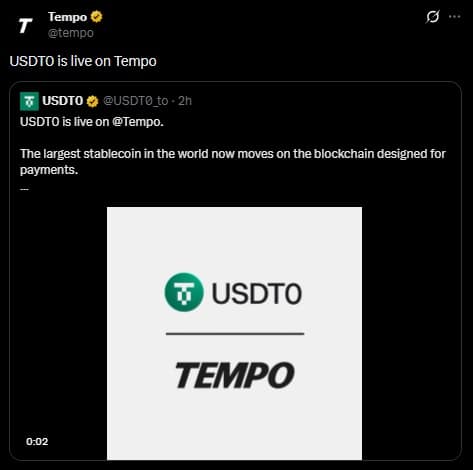
Tempo Integrates USDT0 for Unified Payments
Tempo Integrates USDT0 for Unified Payments
Tempo integrates USDT0 to power unified omnichain payments, bringing efficiency to on-chain transactions. This integration is key to unifying fragmented markets.
What is Tempo and Its Relevance
Tempo is a Layer 1 network designed for efficient and large-scale on-chain payments, incubated by Stripe and Paradigm. It counts Visa, Shopify, and OpenAI among its active participants.
Benefits for Institutions
Tempo's architecture combines sub-second confirmation times, congestion-resistant execution, and a native stablecoin model, targeting the operational needs of fintech companies and e-commerce platforms.
USDT0 Integration and Omnichain Finance
The USDT0 integration connects Tempo to the canonical USDT supply, eliminating reliance on third-party bridges and liquidity fragmentation. This simplifies product integration and reduces custom engineering.
- Deeper pools and tighter spreads
- Faster market formation through a single standard asset
- Predictable costs and high capital turnover
Key Benefits of Unified Payments
The integration enables dollar liquidity to circulate quickly and predictably across all widely used chains in the blockchain industry, making Tempo a new node in omnichain finance infrastructure.
Operational Efficiency
With sub-second confirmation times and congestion-resistant execution, Tempo enhances the operational efficiency of payment systems and trading platforms.
Key Takeaways
- Tempo integrates USDT0 for unified omnichain payments
- Eliminates reliance on third-party bridges and liquidity fragmentation
- Enables predictable costs and high capital turnover
- Enhances operational efficiency for institutions
Frequently Asked Questions
What is the primary benefit of Tempo's USDT0 integration?
The primary benefit is the elimination of reliance on third-party bridges and liquidity fragmentation, simplifying product integration.
How does Tempo's architecture support institutional needs?
Tempo's architecture combines sub-second confirmation times, congestion-resistant execution, and a native stablecoin model, directly targeting the operational needs of fintech companies and e-commerce platforms.