Rochard Flags Missing Bitcoin Guidance
Rochard Flags Missing Bitcoin Guidance
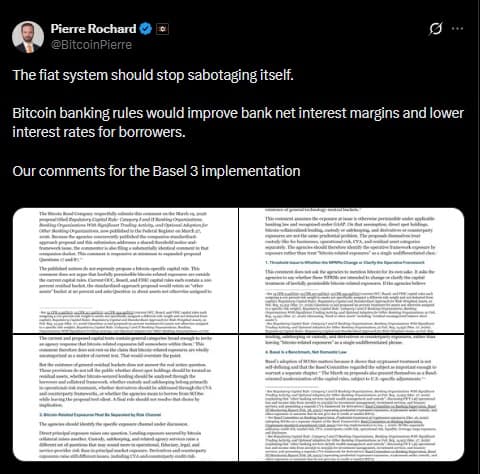
Pierre Rochard warns US regulators about omitting Bitcoin guidance in Basel III reform, leaving regulatory gaps. Rochard flags missing Bitcoin guidance as a major concern.
Basel III Reform and Bitcoin
The March 19 proposal package does not mention Bitcoin, cryptocurrencies, or digital assets, raising questions about how existing categories would apply to direct BTC holdings, Bitcoin-collateralized loans, custody, and derivatives. The Basel Committee already contemplates a 1,250% risk weight for unbacked crypto assets such as Bitcoin.
Regulatory Gaps
Rochard notes that a rule that silently imposes a capital treatment for Bitcoin could be legally vulnerable. Without clear rules, uncertainty spreads across the entire banking industry seeking to operate with Bitcoin.
Bitcoin Banking and Regulations
Clear Bitcoin banking rules would improve net interest margins and reduce rates for borrowers. Rochard argued that the fiat system should stop sabotaging itself. The lack of clarity on Bitcoin-related activities could have concrete consequences, including 1,250% risk weight for unbacked crypto assets.
Tokenized Securities
On March 5, the same agencies published a FAQ guidance on tokenized securities, declaring they should receive the same capital treatment as their non-tokenized equivalents and that the framework is “technologically neutral.” For Bitcoin, no comparable clarification exists.
Key Takeaways
- Rochard flags missing Bitcoin guidance in US Basel III reform
- Regulatory gaps raise questions about Bitcoin-related activities
- Clear Bitcoin banking rules could improve net interest margins and reduce rates
- Uncertainty spreads across the banking industry without clear rules
Frequently Asked Questions
What is the current state of Bitcoin regulation in the US?
The current state of Bitcoin regulation in the US is unclear, with a lack of guidance on Bitcoin-related activities.
How could clear Bitcoin banking rules benefit the industry?
Clear Bitcoin banking rules could improve net interest margins and reduce rates for borrowers, benefiting the entire banking industry.