RippleX Exec: Regulatory Harmony Unlocks Growth
RippleX exec emphasizes regulatory harmony as key to unlocking XRPL tokenization growth, citing unclear legal frameworks and fragmented regulations as central obstacles.
Regulatory Fragmentation: A Barrier to Adoption
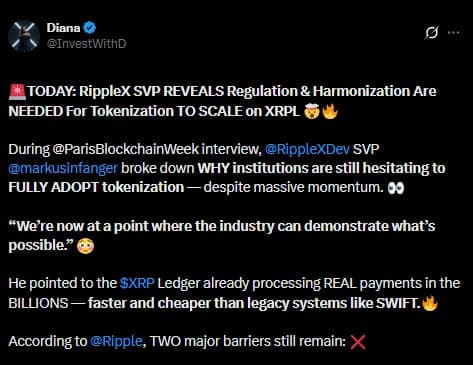
Markus Infanger, SVP of RippleX, notes that limited regulatory clarity acts as a first-order barrier in sectors such as banking and asset management, discouraging significant capital volumes and stalling initiatives.
Technological Infrastructure in Place
The XRP Ledger already processes billions of dollars in payments and offers fast, low-cost settlement with definitive finality, positioning it as a strong alternative to legacy systems like SWIFT.
Tokenization and Regulatory Convergence
For tokenization to reach global scale, regulatory frameworks must converge, with coherent standards that can be applied across borders, according to Infanger.
Expanding Financial Accessibility
Monica Long, president of Ripple, notes that the potential of the XRP Ledger extends beyond payments and could support sovereign identity while expanding financial accessibility to populations excluded from the traditional system.
Key Takeaways
- Regulatory harmony is crucial for unlocking XRPL tokenization growth.
- Unclear legal frameworks and fragmented regulations hinder institutional adoption.
- The XRP Ledger has operational infrastructure in place, but regulatory clarity is needed.
- Tokenization can expand financial accessibility and support sovereign identity.
Frequently Asked Questions
What is the main obstacle to XRPL tokenization growth?
Regulatory fragmentation and unclear legal frameworks are the main obstacles to XRPL tokenization growth.
How can regulatory convergence support tokenization?
Regulatory convergence can support tokenization by providing coherent standards that can be applied across borders, enabling institutions to participate with full legal certainty.