Malicious Axios Release Sparks Fears
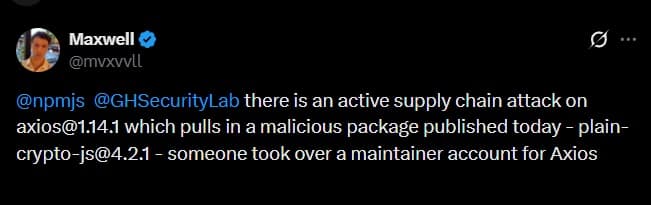
A recent malicious Axios release sparks fears of a supply-chain breach in the crypto ecosystem, with two compromised versions of the package published through the lead developer's credentials.
Axios Supply Chain Attack
The attack on Axios, a widely used JavaScript library with over 100 million downloads, was identified by the teams at StepSecurity and Socket Security. Feross Aboukhadijeh, CEO and co-founder of Socket Security, explained that the compromised versions did not follow the standard GitHub publishing workflow, raising suspicions.
Malicious Package Analysis
Trojan Injection and Remote Access
The malicious packages injected an undeclared dependency into the original source code: plain-crypto-js@4.2.1, published just minutes before the affected Axios versions. This dependency executed a post-installation script active on macOS, Windows, and Linux, delivering a remote access trojan capable of executing commands and deploying additional binaries.
Escalating Frequency of Attacks
This incident comes just one week after another case of malicious code injection into LiteLLM, suggesting that the frequency of this type of attack is escalating. Researchers also identified two additional packages operating through the same mechanism: @shadanai/openclaw and @qqbrowser/openclaw-qbot.
Key Takeaways
- The malicious Axios release sparks fears of a supply-chain breach in the crypto ecosystem.
- No reports of unauthorized cryptocurrency movements have emerged, but wallet exposure cannot be ruled out.
- Security teams recommend reviewing lock files for the compromised versions and avoiding automatic updates without prior inspection.
- The incident highlights the importance of supply chain security and code review in the crypto ecosystem.
Frequently Asked Questions
What is the impact of the malicious Axios release?
The malicious release has sparked fears of a supply-chain breach in the crypto ecosystem, with potential exposure of wallet data.
How can developers protect themselves from similar attacks?
Developers can protect themselves by reviewing lock files for compromised versions, avoiding automatic updates without prior inspection, and implementing secure coding practices.